What Chinese Internet Buzzwords Reveal About Contemporary China
By Giorgia Sgueglia and Xhesjana Haxhiu
Like every year, 2026 has brought a new wave of expressions that have circulated widely across Chinese social media platforms. These “internet buzzwords” (网络流行语, wǎngluò liúxíng yǔ) reflect not only linguistic creativity but also deeper social dynamics. Several Chinese publications and institutions compile annual lists of the most influential buzzwords of the year. Among the most notable are Yao Wen Jiaozi (咬文嚼字), a magazine dedicated to monitoring the evolution and misuse of language in Chinese society; Language and Characters Weekly (语言文字周报), which tracks emerging linguistic trends; the business media outlet 36Kr; and the National Language Resources Monitoring and Research Center (国家语言资源监测与研究中心), a research institute affiliated with the Ministry of Education.
These lists provide more than a linguistic snapshot. They capture the mood, concerns, and aspirations of Chinese society, mainly among younger generations, who are the primary creators and users of online language. Internet buzzwords often serve as compressed cultural signals, capturing shared experiences, generational frustrations, humor, and evolving attitudes toward authority, consumption, and personal identity.
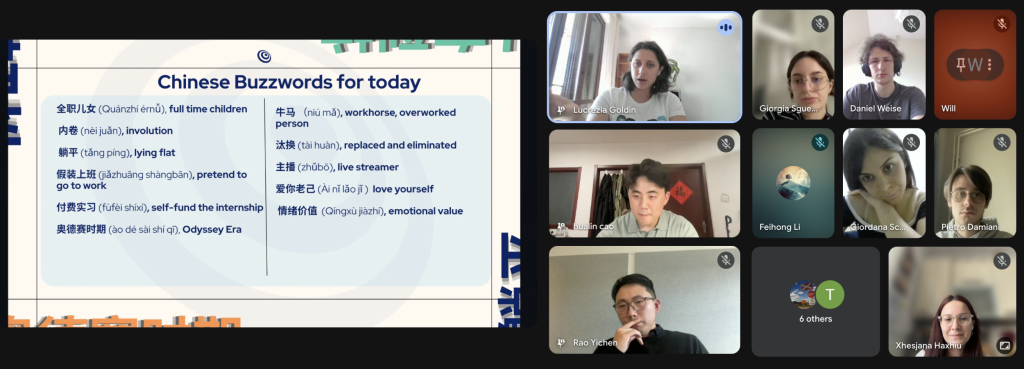
On May 20th 2026, Echoes Cooperation’s Asia Team hosted an online dialogue, in collaboration with Young China Circle and Guang Bridge, to explore these contested narratives. “What Chinese Internet Buzzwords Reveal About Contemporary China” brought together three distinguished experts: journalist Lucrezia Goldin (Sky News Italy), Dr Yichen Rao (Assistant Professor of Cultural Anthropology at Utrecht University), and Hualin Cao (PhD candidate at Leiden University). Their combined expertise in digital discourse, China’s digital sector, and online subcultures enriched a conversation that ranged from digital nationalism practices to the ways digital technologies can reshape economic life, moral worlds, and social relations across global China.
The 90-minute session drew participants from around the world, including scholars, linguistics enthusiasts, students, and volunteers, all seeking to understand how these linguistic trends offer valuable insight into contemporary Chinese society. The session maintained strong engagement throughout its duration.
What We Learned
1. Labour, Family & the Job Market
The dialogue opened with a guiding question: “What are ‘internet buzzwords’ in the Chinese context, and why have they become such a powerful lens for understanding contemporary society?” Lucrezia Goldin opened the discussion by noting that the Chinese internet operates differently from Western platforms: “they are more constrained, yet remarkably creative within those limits”. She pointed to the linguistic dimension as the most compelling aspect,
given how Chinese grammar and lexical structure lend themselves to wordplay that can soften or disguise sensitive content. Hualin Cao traced this creativity to gaming culture, where new terms are coined by ordinary users and spread unpredictably once they catch on; for him, tracing how individual words first emerged is one of the most interesting aspects of the phenomenon.
Dr Yichen Rao introduced the cultural and psychological dimension of these terms, noting that, for example, “involution” (内卷, nèi juǎn) originates from a psychological theory, describing a hyper-competitive social pressure. He also cited the buzzword “full-time children” (全职儿女, quánzhí érnǚ) as a striking example, explaining that, unlike their parents who came of age during a period of relative stability, today’s young adults are choosing to care for their parents and work within the family rather than pursue careers in the wider economy. Dr Rao reads this less as a renewal of traditional filial piety than as a more self-centered adaptation, born of an inability to achieve financial independence or build a career and family of one’s own. He linked this directly to the “involution” buzzword discussed above, observing that some young people now fund their own internships at major companies simply to gain the professional experience needed to remain competitive.
The conversation turned to “replaced and eliminated” (汰换, tàihuàn), a buzzword capturing anxieties around technological displacement, particularly in IT and coding fields where AI is reshaping entry-level employment. Lucrezia argued that fears of being displaced by automation are not unique to China. Indeed, a highly younger generation finding itself excluded from the job market is a global pattern. However, China’s political narrative reframes AI distinctly: in official discourse, it is presented as a driver of national development rather than a threat, and it does not attract the same blame or resistance as in Western contexts. Hualin Cao added that the sense of being “replaced or eliminated” is concentrated mainly in IT and coding-related fields. While the fear is real among all younger adults, he noted that those born after 2005 appear to express greater institutional trust and tend to share a more optimistic outlook tied to the goal of common prosperity, complicating straightforward readings of youth anxiety.
2. Identity, Wellness & Aesthetics
On wellness and mental health, Lucrezia observed that consumption is increasingly treated as a form of psychological treatment itself and is a pattern that extends well beyond younger generations, reflecting the growing complexity of contemporary life. The panel identified one exception to this pattern: platforms like Xiaohongshu (Little Rednote) host trends such as colour walk, which were seen as a more genuine alternative to consumerist wellness.
The discussion of aspiration and aesthetics revealed an equally layered picture. The proliferation of highly specific body and beauty buzzwords, such as “thin muscles man” (薄肌男, báojī nán) or “fish in collarbone” (锁骨养鱼, suǒgǔ yǎng yú), reflects shifting beauty standards and a wider search for identity and belonging in digital micro-communities, where niche categories offer a sense of safety and recognition. Dr Rao traced shifts in masculinity by K-pop aesthetics and the entertainment industry, including the resurgence of 1980s-style idols, actors, and songs from television series. Lucrezia pointed to the return of extreme thinness as a female beauty standard as structurally significant: a reinforcement of patriarchal norms that narrows the space women occupy in the public sphere to the body, at a moment when their presence in political and professional life remains constrained.
3. Nostalgia & Soft Power
The final block addressed digital nostalgia, centred on dreamcore aesthetics that recreate the visual and sensory world of early-2000s China. Dr Rao described it as an attempt to recapture the feeling of China before rapid modernisation, arguing that “a brighter, more modern future does not necessarily translate into greater happiness”. Hualin Cao suggested that this kind of nostalgia is a universal generational experience, only now given a name and an aesthetic through internet culture, though he cautioned that “people tend to miss only fragments of the past, not the whole of it”. Lucrezia agrees that dreamcore‘s appeal lies less in any genuine interest in returning to the past than in a broader shift in how people relate to the future: looking backward, she suggested, is often what people do when the future feels difficult to picture. Nostalgia, the panel agreed, has been rapidly marketised, with companies and creators packaging memory as a consumable aesthetic experience.
The conversation then moved to audience questions of soft power. One participant observed that both the West and China are shaping cultural narratives in opposite directions: the West has its China-maxxing, while China has its “kill line“. Dr Rao explained that China-maxxing reflects China becoming a lifestyle symbol rather than a literal subject of interest, driven by the country’s growing openness to foreigners and Western audiences; “kill line“, meanwhile, functions as a kind of mediating term that informs Chinese audiences about perceived insecurity in the United States. In his view, both trends ultimately reinforce a more positive image of China, simply by different routes.
On the question of political alignment and the future of critical buzzwords, the experts agreed that dissatisfaction will continue to find expression in internet language, but that algorithmic amplification is likely to make aligned content increasingly dominant. The term “alignment” (对齐, duìqí), borrowed from IT and AI discourse, has itself entered political vocabulary, signalling a blurring of technical and political language.
Looking Ahead
The session closed by noting that many of the challenges surfaced through these buzzwords, such as precarity, displaced aspiration, emotional exhaustion, and an uncertain relationship with the future, are far from exclusively referring to Chinese youth; they resonate across generations and countries. More than one participant noted how striking it is that consumption has become one of the only widely available ways of coping with that disillusionment. Closing reflections turned to a wider concept some have called the “Odyssey Era”: the unsettled, exploratory years between roughly twenty and thirty-five, marked by job changes, shifting relationships, and the search for one’s own path. Now reframed not as falling behind, but as an extended, contemporary stage of growing up. Read together, the buzzwords discussed throughout the session can be seen as different expressions of this same odyssey: a generation testing new ways to define stability, ambition, and belonging on its own terms.
Internet buzzwords, in this sense, offer a remarkable and unique instrument for reading what young people feel but do not always say openly. The dialogue reaffirmed Echoes Cooperation’s commitment to continuing to follow Chinese social media and the evolution of its language, as a window into the feelings and experiences of younger generations in China. As these expressions keep evolving, so will the questions worth asking about what they reveal, making this a conversation worth returning to.